

Signature procedure · 눈밑지방재배치
Under-Eye Fat Repositioning in Gangnam, Seoul
Medically reviewed by Dr. Lee Young-geun, board-certified plastic surgeon · Last reviewed:
The operation this clinic was built around. Rather than cutting the bulging fat away, it is released and laid down into the hollow beneath it — so the lid and the cheek become one smooth plane again, and the shadow that reads as a dark circle disappears.
Procedure Comparison: Which Eye Bag Surgery Fits You?
Choosing the correct lower eyelid procedure is vital. Dr. Lee Young-geun compares the three primary surgical approaches below:
| Feature | Under-Eye Fat Repositioning | Under-Eye Fat Removal | Lower Blepharoplasty |
|---|---|---|---|
| Incision / Scar | Scarless (Inside conjunctiva) | Scarless (Inside conjunctiva) | Discreet subciliary line below eyelashes |
| Best Candidates | Bulging fat + tear trough hollow | Young patients, isolated bulge, no hollow | Bulging fat + loose, wrinkled, sagging skin |
| Tear Trough Treatment | Smoothly filled with transposed fat | Not addressed (can worsen hollows) | Smoothly filled with transposed fat |
| Skin Laxity Trimmed | No skin excised (preserves skin) | No skin excised | Yes, excess redundant skin excised |
| Surgical Duration | 45 – 60 minutes | 30 – 40 minutes | 60 – 80 minutes |
| Stitch Removal / Downtime | No stitch removal; 2–3 days recovery | No stitch removal; 2–3 days recovery | Stitch removal at Day 5–7; 7 days recovery |
Quick answer
Under-eye fat repositioning is eye bag surgery that moves the bulging lower-eyelid fat down into the tear-trough groove instead of removing it, working from inside the eyelid with no external scar. At SINSA L in Gangnam, Seoul it is the operation for patients who have both a bulge and a dark groove beneath it.
Medically reviewed by Dr. Lee Young-geun, board-certified plastic surgeon · Last reviewed
Overview
What under-eye fat repositioning actually solves
An under-eye bag is not simply excess fat. It is a relief problem: the orbital fat has pushed forward over a weakened septum, while just below it the ligament that anchors the skin to the orbital rim holds a groove down. The eye reads as tired because light falls into that groove and casts a shadow — what most patients call a dark circle.
Under-eye fat repositioning (눈밑지방재배치) treats the two halves of that problem with one movement. The fat that creates the bulge is not thrown away; it is released from its compartment, slid over the bony rim and used as a natural filler inside the hollow. The hill is used to fill the valley. Nothing is added, nothing is wasted, and the volume that gives a young lower lid its smooth transition into the cheek is preserved instead of discarded.
This is the operation Dr. Lee performs more than any other, and the reason the clinic keeps its scale small on purpose. A lower eyelid is a few millimetres of tissue — the margin between an excellent and a mediocre result is smaller than the width of a suture.
Terminology
What under-eye fat repositioning is also called
Most patients arrive calling this “eye bag surgery”. That name covers several different operations; this is the one that keeps the fat and moves it into the groove instead of throwing it away.
- Transconjunctival fat transposition
- Tear trough fat repositioning
- Arcus marginalis release with fat transposition
- Eye bag surgery (fat-preserving)
- Under-eye bag correction
- Tear trough surgery
- Dark circle surgery
If you were told one of these names abroad, you are on the right page — they describe the operation Dr. Lee performs as under-eye fat repositioning (눈밑지방재배치) here in Sinsa, Gangnam, Seoul.
Candidacy
Who this procedure is — and is not — for
We would rather turn an operation down than perform one that will not help you. These are the honest boundaries of this procedure.
A good candidate
- A bulge under the eye that is more visible in the afternoon or in downward light
- A defined groove (tear trough) running from the inner corner towards the cheek
- Dark circles that improve when you stretch the skin or lift the cheek with a finger
- Skin that is still reasonably elastic and does not fold when smiling
- Patients in their late twenties to fifties who want a change nobody can name
Better served by something else
- Significant loose lower eyelid skin — a lower blepharoplasty may suit better
- Pigment-type dark circles from melanin or allergy, which surgery will not change
- Fluid-type puffiness from thyroid, kidney or sleep problems
- Marked lower lid laxity or scleral show, which may need canthal support
- Unrealistic expectations of a total change in how the eyes are shaped
The detail that decides the result
Why we reinforce the septum
Repositioning fat is only half of a durable result. If the orbital septum — the thin membrane that was holding the fat back in the first place — is left as it was found, the same weakness that produced the bag remains. Over years, fat can push forward again.
Dr. Lee's standard is septal reinforcement (격막강화): after the fat flap is laid into the tear trough and fixed, the septum is tightened and re-supported so the compartment is restored, not just emptied. It adds time to the operation. It is the reason the clinic does not run parallel operating rooms.
Surgical sequence
How under-eye fat repositioning is performed at SINSA L
Every step below is carried out by Dr. Lee Young-geun himself, from the first marking to the final suture.
Assess the rim, not just the bag
Under loupe magnification and in several gaze positions, the orbital rim, the tear trough ligament and the amount of true fat herniation are mapped. Two patients with an identical bulge often need different amounts of transposition.
Transconjunctival access
A small incision is made inside the lower lid. Skin, orbicularis muscle and the lash line are never cut, which is why there is no external scar and why the lid margin keeps its original position.
Arcus marginalis release
The periosteal attachment along the orbital rim is released so the fat can travel below the rim. Without a complete release, the fat springs back and a step-off remains.
Transposition and fixation
The fat is kept as a pedicled flap with its own blood supply — not as a free graft — and spread evenly into the hollow, then secured so it holds its new position while it heals.
Septal reinforcement
The septum is tightened and re-supported to restore the barrier, reducing the chance of recurrent bulging.
Symmetry check while awake
Before closing, the patient is asked to open the eyes and look up and down. Final adjustments are made against a live face, not a photograph.
Before & after
Under-Eye Fat Repositioning results, photographed the same way every time
Standardised distance, lighting and angle. Each photograph is a consented patient of SINSA L Plastic Surgery Clinic in Gangnam, Seoul, Korea, and every case shown was operated by Dr. Lee Young-geun himself.

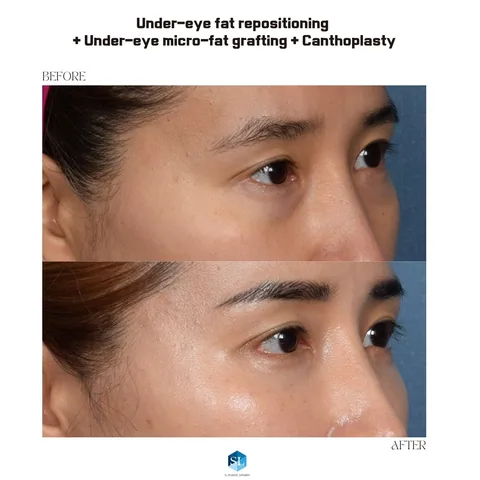


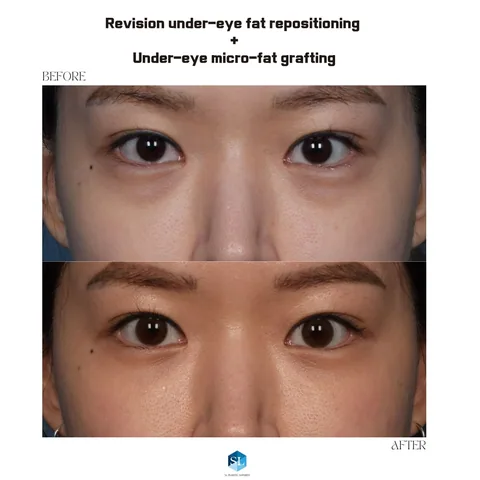

Recovery
What the healing actually looks like
Timelines vary between patients. These are the ranges we tell our own patients to plan around — not best cases.
Every follow-up appointment is with Dr. Lee. If something worries you between visits, you reach the clinic directly — there is no call centre in between.
| Day 0 | Cold compression, head elevated. Mild pressure rather than pain. Vision is normal. |
|---|---|
| Day 1-3 | Swelling peaks. Some patients have bruising inside the white of the eye, which is harmless and clears on its own. |
| Day 3-5 | Review at the clinic. Most office workers return to work. No stitches to remove. |
| Week 2 | Most visible swelling has settled. Light make-up is usually fine. |
| Week 4-6 | The contour looks natural to other people. Exercise resumes. |
| Month 3-6 | Final settling. The transposed fat has fully integrated in its new position. |
Risks & honesty
What can go wrong
As with any eyelid operation, temporary swelling, bruising, subconjunctival haemorrhage, dry eye sensation, mild asymmetry during healing, over- or under-correction, and — rarely — the need for a revision. A transconjunctival approach avoids an external scar but does not eliminate surgical risk. Dr. Lee discusses each of these with you in person before you decide.
Surgical results differ from person to person according to anatomy, skin quality, age and healing response. Every procedure carries risk, including bruising, swelling, asymmetry and the possibility of revision. The content on this site is general information, not a diagnosis or a guarantee of outcome. A face-to-face consultation with Dr. Lee is required before any operation is planned.
How the four under-eye operations compare
Each operation answers a different kind of under-eye. Dr. Lee chooses after examining the bulge, the groove and the skin.
| Operation | Best for | Approach | What happens to the fat | Operating time |
|---|---|---|---|---|
| Under-eye fat repositioning | A bulge with a tear-trough groove beneath it | Inside the eyelid, no external scar | Moved down into the groove, septum reinforced | About 40-60 minutes |
| Under-eye fat removal | A bulge with firm skin and no groove | Inside the eyelid, no visible scar | Taken out | About 30-40 minutes |
| Lower blepharoplasty | A bulge with loose, creped skin | Fine line just under the lash line | Treated, with excess skin trimmed and the eye corner supported | About 60-90 minutes |
| Micro fat grafting | A hollow with no significant bulge | Needle-sized entry points | The patient's own fat added in tiny droplets | About 40-60 minutes |
FAQ
Under-Eye Fat Repositioning — frequently asked questions
What is the difference between under-eye fat repositioning and under-eye fat removal?
Fat removal simply takes the bulging fat out. Fat repositioning moves that same fat down into the hollow below the rim, so the bulge disappears and the groove is filled at the same time. If a patient has a real tear trough, removal alone can leave the under-eye looking flatter but still shadowed, and in some cases more hollow with age. Repositioning is the right answer when both a bulge and a groove exist together.
Will there be a visible scar?
No external scar. The incision is made inside the lower eyelid on the conjunctival surface, which heals without a mark on the skin. Nothing needs to be removed afterwards.
Does it fix dark circles?
It fixes the kind of dark circle caused by shadow — where a bulge and a groove create relief on the face. It does not change pigment-type dark circles from melanin, allergic rubbing or thin skin showing the vessels underneath. Dr. Lee tells you which type you have at the consultation, and will say so plainly if surgery is not the answer for you.
How long does the result last?
The repositioned fat stays where it is placed; it is living tissue with its own blood supply. Ageing continues everywhere else, so the face keeps changing, but the specific problem that was corrected does not usually come back in the same form — particularly when the septum has been reinforced.
Can it be combined with other procedures?
Yes. It is often combined with micro fat grafting when the hollow extends beyond what the transposed fat can cover, or with a lower blepharoplasty when there is excess skin. Both are decided at the consultation, not sold in advance.
Is general anaesthesia necessary?
No. It is performed under local anaesthesia with sedation, so you are comfortable and drowsy but able to open your eyes when asked for the symmetry check. You go home the same day.
Can international patients have this done on a short trip?
Yes. Most international patients plan 5-7 days in Seoul: consultation and surgery on the first or second day, a review on day 3-5, and flight home after that. There are no stitches to remove. See the international patients page for a full timeline.
Is this the same as eye bag removal surgery?
Not quite. Eye bag removal takes the bulging fat out. Fat repositioning keeps that fat and moves it down into the hollow underneath, so the bulge is flattened and the groove is filled in one operation. If you have a bulge and a shadowed groove together, repositioning usually gives the smoother result; if you have a bulge and no groove at all, simple removal may be enough. Dr. Lee decides this at the examination, not from a photograph.
Will this get rid of my dark circles?
It depends on what is making them dark. If the darkness is a shadow cast by the bulge and the groove beneath it, correcting the contour removes the shadow and the area looks brighter. If the darkness is pigment in the skin or visible blue veins, surgery will not change it, and we will tell you that at the consultation rather than let you find out afterwards.
Related
Often considered together
Lower Blepharoplasty
When the problem is no longer only fat but skin as well, the lower eyelid has to be re-draped rather than emptied. Done…
눈밑지방제거Under-Eye Fat Removal
The simplest of the under-eye operations — and the easiest to get wrong. Removing too much fat is not reversible, and an eye that has…
미세지방이식Micro Fat Grafting
The under-eye is the least forgiving place on the face to add volume. Skin here is under half a millimetre thick, and anything placed…
Consultation
Ask Dr. Lee whether under-eye fat repositioning is right for you
One surgeon, one consultation room. You will be examined and advised by the same person who would operate — in English, in person at the clinic in Sinsa.
Every consultation is carried out by Dr. Lee Young-geun in person — never by a coordinator.
Transparent Medical Fees
Estimated Procedure Cost in Gangnam, Seoul
At SINSA L Plastic Surgery, Dr. Lee Young-geun provides honest, transparent surgical quotes with zero hidden hospital fees or foreigner surcharges.
* Note: Exact fees vary depending on personal anatomy, septal laxity, whether fat grafting is combined, and revision complexity. Final quotes are confirmed during Dr. Lee Young-geun's direct in-person evaluation.