

Eye surgery · 상안검
Upper Eyelid Surgery (Upper Blepharoplasty) in Seoul
Medically reviewed by Dr. Lee Young-geun, board-certified plastic surgeon · Last reviewed:
When upper eyelid skin descends far enough to rest on the lashes, the eye stops looking open and the forehead starts working overtime to compensate. The correction is simple in principle and unforgiving in measurement.
Quick answer
Upper blepharoplasty, or upper eyelid surgery, removes the fold of loose skin that rests on the lashes in hooded eyelids. At SINSA L the amount is measured with the patient sitting up and removed conservatively, with the scar hidden in the natural crease. It does not lift a droopy lid margin — that is ptosis.
Medically reviewed by Dr. Lee Young-geun, board-certified plastic surgeon · Last reviewed
Overview
What upper blepharoplasty actually solves
Upper blepharoplasty (상안검수술) removes the redundant skin that has descended over the upper eyelid. In many patients the lid has become heavy enough that the forehead muscle lifts constantly to keep the eye open — which is why deep horizontal forehead lines and heavy lids so often appear together.
The operation is not simply a skin excision. How much skin can safely be removed depends on where the eyebrow sits, how strong the levator muscle is, and whether the heaviness comes from the lid or from a descended brow. Removing skin from a patient whose real problem is a low brow produces an eye that still looks heavy and a brow pulled further down.
Dr. Lee marks every case with the patient seated upright, brow relaxed, and measures the remaining skin between the crease and the brow before deciding the excision. The aim is a lid that opens comfortably and still looks like the patient's own eye — not a surprised one.
Terminology
What upper blepharoplasty is also called
Searched in English as upper eyelid surgery, eyelid lift or hooded eyelid surgery. All three describe removing the fold of skin that has come to rest on the lashes.
- Upper eyelid lift
- Hooded eyelid correction
- Senile blepharoplasty
- Upper eyelid surgery
- Eyelid lift
- Hooded eyelid surgery
- Droopy eyelid skin removal
- Eyelid surgery for excess skin
If you were told one of these names abroad, you are on the right page — they describe the operation Dr. Lee performs as upper blepharoplasty (상안검) here in Sinsa, Gangnam, Seoul.
Candidacy
Who this procedure is — and is not — for
We would rather turn an operation down than perform one that will not help you. These are the honest boundaries of this procedure.
A good candidate
- Upper eyelid skin resting on or over the lashes
- A constantly raised forehead and deep horizontal brow lines
- Eyes that look heavy or tired regardless of sleep
- Patients typically from their forties onwards
Better served by something else
- Heaviness caused mainly by a descended brow, which needs a different operation
- Significant ptosis, where the eyelid muscle itself is weak — this needs ptosis correction
- Severe dry eye without ophthalmological clearance
The detail that decides the result
Measure seated, not lying down
An upper eyelid marked while the patient is lying down, or while the brow is unconsciously raised, will be over-resected. The consequence — an eyelid that cannot close fully — is far more difficult to treat than leaving a millimetre of skin behind.
Every marking here is done seated, with the brow rested, and re-checked after the patient looks up and closes the eyes. It costs five minutes. It prevents the one complication no patient forgives.
Surgical sequence
How upper blepharoplasty is performed at SINSA L
Every step below is carried out by Dr. Lee Young-geun himself, from the first marking to the final suture.
Brow-first assessment
Whether the heaviness comes from the lid, the brow or both decides the operation. Some patients need a brow procedure rather than an eyelid one.
Seated marking
The crease and the excision are marked upright with the brow relaxed, and the residual skin between crease and brow is measured to guarantee full closure afterwards.
Conservative excision
The minimum skin that solves the hooding is removed. Orbicularis and fat are reduced only where genuinely surplus — over-hollowing the upper lid ages it.
Crease reconstruction
The crease is re-formed at a height suited to the patient's age and anatomy, which is what keeps the result looking natural rather than operated.
Fine closure
Closed with fine sutures placed to keep the line within the crease shadow.
Before & after
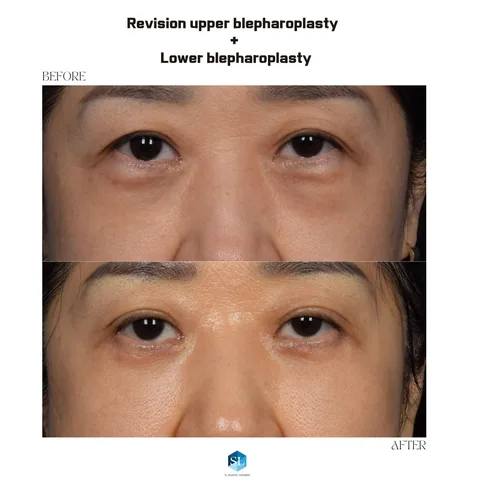
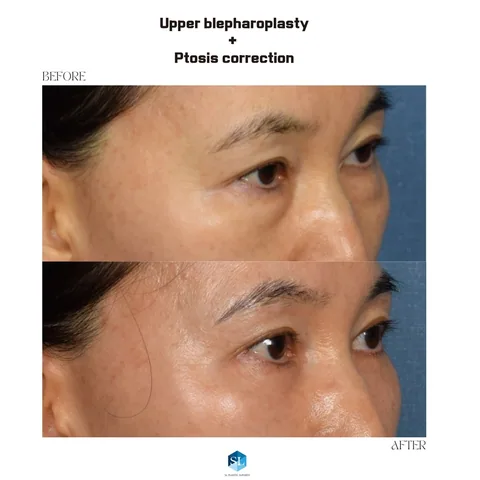
Upper Blepharoplasty results, photographed the same way every time
Standardised distance, lighting and angle. Each photograph is a consented patient of SINSA L Plastic Surgery Clinic in Gangnam, Seoul, Korea, and every case shown was operated by Dr. Lee Young-geun himself.




Recovery
What the healing actually looks like
Timelines vary between patients. These are the ranges we tell our own patients to plan around — not best cases.
Every follow-up appointment is with Dr. Lee. If something worries you between visits, you reach the clinic directly — there is no call centre in between.
| Day 0-2 | Cold compression and head elevation; swelling and bruising are expected. |
|---|---|
| Day 5-7 | Sutures removed; make-up usually possible shortly afterwards. |
| Week 2-3 | Most swelling settled; the line is pink and softening. |
| Month 3-6 | The crease looks natural and the line is hard to find. |
Risks & honesty
What can go wrong
Swelling, bruising, temporary dryness or difficulty closing the eyes fully, asymmetry of crease height during healing, visible line early on, and — with over-resection — incomplete lid closure. Conservative measurement is the principal safeguard.
Surgical results differ from person to person according to anatomy, skin quality, age and healing response. Every procedure carries risk, including bruising, swelling, asymmetry and the possibility of revision. The content on this site is general information, not a diagnosis or a guarantee of outcome. A face-to-face consultation with Dr. Lee is required before any operation is planned.
How the eyelid operations compare
Hooded skin, a missing crease and a droopy lid look similar but are different problems with different operations.
| Operation | Best for | What is changed |
|---|---|---|
| Upper blepharoplasty | Hooded eyelids where a skin fold rests on the lashes | Loose skin is removed, measured with the patient sitting up; the scar is hidden in the natural crease. It does not lift the lid margin. |
| Double eyelid surgery | No crease, or a crease that needs refining | The crease is created or refined by the buried-suture, partial-incision or full-incision method, chosen by lid thickness, skin and fat. |
| Ptosis correction | An eyelid margin that sits too low | The levator muscle that opens the eye is adjusted, with the height checked while the eye is open. |
FAQ
Upper Blepharoplasty — frequently asked questions
What is the difference between upper blepharoplasty and double eyelid surgery?
Double eyelid surgery creates or refines a crease in an eyelid that has none or an unstable one, usually in younger patients. Upper blepharoplasty removes skin that has descended with age. The incision may look similar; the problem being solved is entirely different.
Will my eyes look unnaturally big?
Not if the excision is conservative and the crease height suits your age. An over-high crease and over-resected skin are what produce a startled look.
Can it be done at the same time as lower eyelid surgery?
Yes, and it is a common combination — one anaesthetic and one recovery rather than two.
Will it help my forehead wrinkles?
Often, indirectly. When the lid no longer needs to be held up by the forehead, many patients stop raising their brows constantly and the horizontal lines soften over time.
How long should international patients stay?
Eight to ten days, so that sutures can be removed and a final check performed before flying.
Is upper eyelid surgery the same as an eyelid lift?
Yes — “eyelid lift” is the everyday phrase for upper blepharoplasty. It removes the excess skin, and sometimes a strip of muscle, so the upper lid is open and the lashes are clear again. What it does not do is raise the eyelid margin itself; if the lid edge sits low over the pupil, that is ptosis and needs a different operation.
How do I know if I need an eyelid lift or ptosis correction?
Look at where the problem is. If a fold of loose skin hangs over an otherwise normally positioned lid, you need skin removed — an eyelid lift. If the lid margin itself sits low, covering part of the iris, and you raise your eyebrows to see comfortably, that is ptosis and the muscle has to be adjusted. Many patients have both. This is exactly the distinction a seated, awake examination is for.
Related
Often considered together
Ptosis Correction
A crease makes an eyelid look folded. Only the muscle makes an eye look open. Ptosis correction adjusts the muscle that lifts the lid…
쌍꺼풀Double Eyelid Surgery
A crease that suits the face it is on. The method is chosen from the anatomy in front of us — eyelid thickness, skin, muscle strength…
하안검Lower Blepharoplasty
When the problem is no longer only fat but skin as well, the lower eyelid has to be re-draped rather than emptied. Done…
Consultation
Ask Dr. Lee whether upper blepharoplasty is right for you
One surgeon, one consultation room. You will be examined and advised by the same person who would operate — in English, in person at the clinic in Sinsa.
Every consultation is carried out by Dr. Lee Young-geun in person — never by a coordinator.